
Read Our Blogs
Helpful blogs written by experts
Helpful blogs written by experts
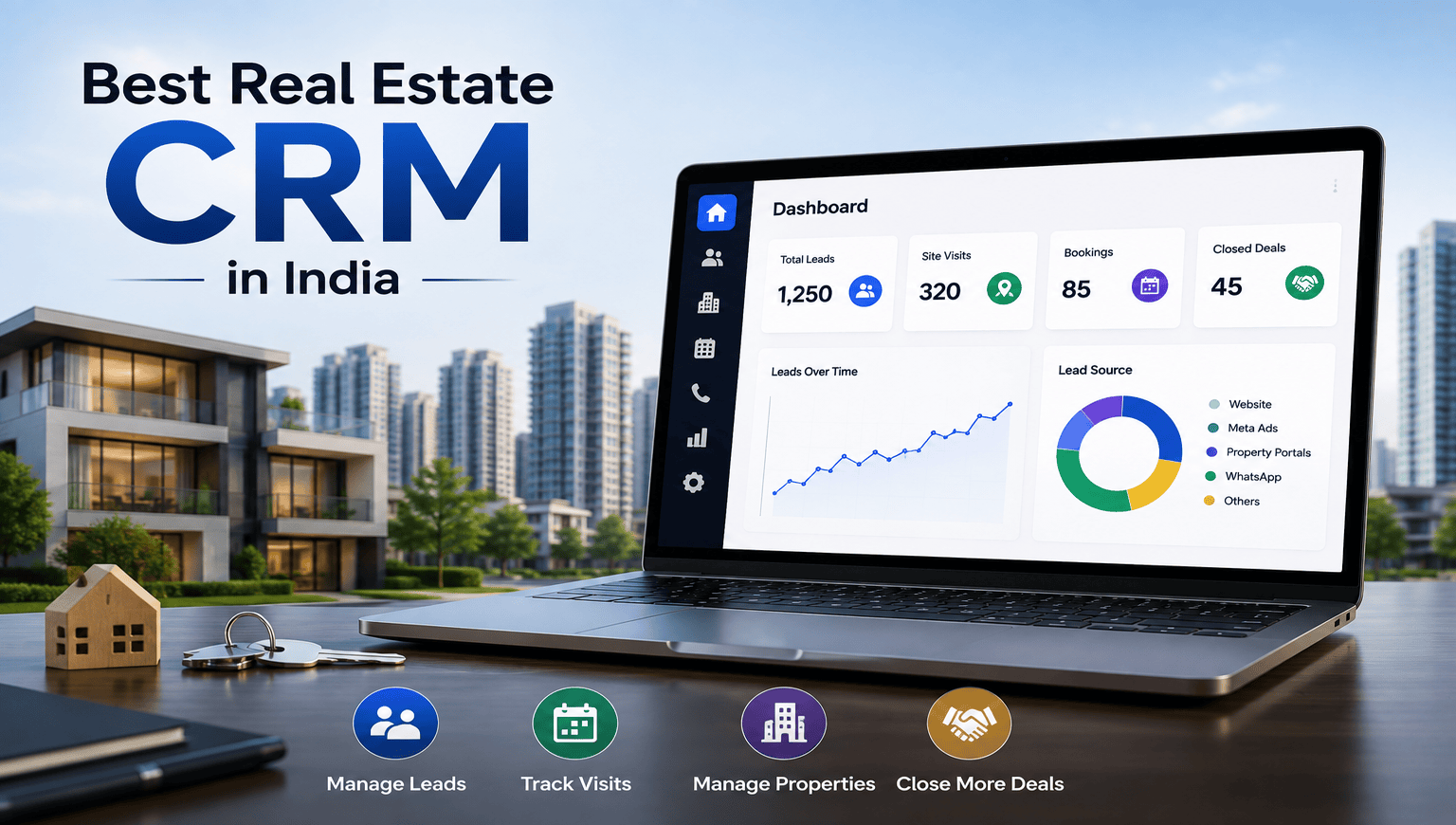
Choosing a CRM for your real estate business can be confusing.
There are plenty of options in the market, and most of them promise better lead management, faster follow-ups, and more sales.
But here's the thing:
The best CRM isn't necessarily the one with the most features.
It is the one that fits your sales process, is easy for your team to use, and solves the problems you're actually facing.
A broker handling 100 leads a month doesn't need the same CRM as a developer managing multiple projects, hundreds of salespeople, and thousands of enquiries.
So, instead of simply asking "Which CRM is number one?", let's look at what different businesses actually need.
A real estate CRM helps you manage the journey from the first enquiry to the final sale.
For example:
Lead → Call → Follow-up → Site Visit → Negotiation → Booking
Instead of keeping this information across Excel files, WhatsApp chats, phone contacts, and notebooks, the CRM keeps it together.
Modern real estate CRMs also go beyond basic contact management. Platforms such as Sell.Do, for example, combine lead capture, site visits, inventory, channel partners, communication, reporting, and post-sales activities in one system.
Trevion CRM is built around lead management and sales operations, with features designed for businesses that want to keep their sales process in one place.
Its real estate solution covers lead management, follow-ups, site visits, project and property management, live location tracking, WhatsApp CRM, reporting, and integrations. Trevion also positions itself as a CRM for businesses running Meta Ads, with direct Meta integration for lead capture.
Best for: Brokers, builders, developers, and growing real estate sales teams.
Why consider it: Easy setup, real estate-focused workflows, lead management, field-sales features, and centralized sales tracking.
The best option depends on the business. Trevion, Sell.Do, LeadSquared, Buildesk, Leadrat, TeleCRM, Zoho, HubSpot, Salesforce, and Kylas all serve different needs.
Brokers usually benefit from simple lead management, follow-up reminders, calling, WhatsApp communication, property management, and mobile access.
Builders generally need more advanced features such as project management, property inventory, site visits, bookings, reporting, channel-partner management, and post-sales workflows.
If your business depends heavily on property listings, site visits, inventory, bookings, and real estate-specific sales stages, a dedicated real estate CRM can reduce the amount of customization required. General CRMs can be better when flexibility and broader business processes are more important.
Sell.Do is a well-known real estate-focused CRM in India, particularly among developers and larger sales teams.
Its platform covers marketing automation, sales and pre-sales, site visits, inventory, negotiations, channel partners, communication, post-sales, and reporting.
Best for: Mid-sized and large developers with complex sales operations.
LeadSquared combines CRM and marketing automation and is often considered by businesses managing large volumes of leads.
It is particularly useful when lead distribution, automation, sales tracking, and marketing workflows are major priorities.
Best for: High-volume sales teams and businesses running multiple marketing campaigns.
Buildesk is designed specifically for the real estate industry and focuses on areas such as lead management, sales, inventory, site visits, and project operations.
Best for: Builders, developers, and agencies looking for a real estate-specific platform.
Leadrat focuses on real estate sales teams and offers tools for lead capture, follow-ups, property management, team tracking, and sales activities.
Best for: Brokers, agents, and real estate teams that want a dedicated property-sales CRM.
TeleCRM is particularly focused on sales communication, calling, lead management, and follow-ups.
This can make it useful for businesses where salespeople spend a large part of their day calling and following up with enquiries.
Best for: Property dealers, brokers, and telecalling-heavy sales teams.
Zoho CRM is a general-purpose CRM rather than a real estate-only platform.
Its biggest advantage is flexibility. Businesses can customize modules, workflows, fields, reports, and integrations according to their requirements.
The trade-off is that a real estate company may need more customization to create a workflow that feels as natural as a purpose-built real estate CRM. Current comparisons similarly position Zoho as a flexible, cost-conscious option that requires more configuration for real estate-specific workflows.
Best for: Small and mid-sized businesses that want flexibility and customization.
HubSpot is another general CRM that works well for businesses focused on marketing, sales pipelines, and customer relationships.
It has a clean interface and strong marketing capabilities, but real estate-specific workflows may require customization or additional tools.
Best for: Marketing-led agencies and businesses already using HubSpot's wider ecosystem.
Salesforce is an enterprise-level CRM known for its customization and scalability.
It can handle complex sales processes and large teams, but it may be more than a small broker or agency actually needs.
Best for: Large real estate companies and enterprises with complex CRM requirements.
Kylas is a sales CRM aimed mainly at growing businesses and sales teams.
It can be considered by real estate companies that want a straightforward sales CRM without necessarily needing a platform built exclusively around property management.
Best for: Growing agencies and sales teams looking for a general sales CRM.
| CRM | Best For | Real Estate Focus | Best Strength |
|---|---|---|---|
| Trevion | Brokers & builders | High | Real estate sales workflow |
| Sell.Do | Large developers | High | End-to-end developer operations |
| LeadSquared | High-volume teams | Medium-High | Lead automation |
| Buildesk | Builders & developers | High | Property & sales management |
| Leadrat | Brokers & agents | High | Lead & property management |
| TeleCRM | Calling-heavy teams | Medium | Calling & follow-ups |
| Zoho | Growing businesses | Medium | Customization |
| HubSpot | Marketing-led teams | Low-Medium | Marketing & sales |
| Salesforce | Enterprises | Medium | Scalability |
| Kylas | Growing sales teams | Medium | Sales management |
Features and integrations can vary by plan and implementation, so businesses should confirm the current offering before purchasing.
Don't start by looking at the number of features.
Start with your problems.
Your CRM should make it easy to capture, organize, assign, and track enquiries.
If you're receiving leads from multiple sources, Real Estate Lead Management Software should be one of the first things you evaluate.
WhatsApp is already a major communication channel for property sales.
But conversations can easily get lost when salespeople manage everything from their personal chats.
A Real Estate CRM with WhatsApp Integration can help bring customer communication closer to the sales process.
For builders, managing leads is only one part of the job.
You may also need to know which units are available, booked, held, or sold.
That's why Real Estate CRM with Property & Inventory Tracking can be an important requirement for developers managing multiple projects.
A CRM should help salespeople remember who they need to call, when they need to call, and what happened during the last interaction.
This becomes even more important for large teams.
If you have several salespeople handling hundreds of enquiries, a CRM for Real Estate Sales Teams can help managers get better visibility into individual and team performance.
This is often overlooked.
A CRM may have dozens of features, but if your sales team finds it difficult to use, adoption will suffer.
Before buying, give your salespeople a chance to test the system.
Ask them to perform simple tasks:
Add lead → Make call → Add note → Schedule follow-up → Book site visit
If these actions are easy, that's a good sign.

Look for a simple CRM with lead management, calling, WhatsApp, reminders, and mobile access.
Focus on lead capture, follow-ups, property management, communication, and team tracking.
A dedicated CRM for Property Dealers can be useful when you're managing several property enquiries at the same time.
Look beyond basic CRM features.
Project management, property inventory, site visits, bookings, reporting, channel partners, and post-sales activities may be much more important.
This is where a CRM for Builders & Real Estate Developers becomes particularly relevant.
There isn't one answer for everyone.
If you are a large developer looking for deep project and sales operations, a platform such as Sell.Do may be worth considering.
If marketing automation and high-volume lead management are your priorities, LeadSquared may be a better fit.
If you want a flexible general CRM, Zoho, HubSpot, or Salesforce may make sense depending on your size and budget.
And if you want a CRM built around real estate sales workflows, Trevion, Buildesk, or Leadrat may be worth comparing.
The important thing is to match the CRM with your business model, not simply choose the most popular name.

Choosing a real estate CRM is a business decision, not just a software purchase.
Before making the final choice, check your lead sources, sales process, team size, follow-up requirements, property management needs, integrations, reporting, and budget.
Most importantly, ask one simple question:
Will my sales team actually use this every day?
If the answer is yes, you're already much closer to finding the right CRM.
A good CRM should help your team spend less time managing data and more time talking to customers, conducting site visits, and closing deals.
Get all the latest tech updates!


